

Potato Y virus disease, also known as tobacco vein band disease or tobacco vein spot virus disease, manifests different symptoms depending on the viral strain. The primary clinical forms include the vein band mosaic type, vein spot type, and chlorotic spot type. The vein band type exhibits yellow-green mosaic patterns on upper leaves, with lighter interveinal colors and dark green bands along both leaf veins, forming distinct vein bands. Severe cases may show leaf curling or scorch spots, abnormal leaf maturity, uneven coloration, reduced quality, and stunted plant growth. The vein spot type affects lower leaves, presenting yellowish-brown lesions with gray-black or reddish-brown necrosis along the main and lateral veins starting from the leaf base. Petioles become brittle, and removed leaves reveal brown vascular bundles, while stems display reddish-brown or black necrotic streaks. The chlorotic spot type initially resembles the vein band type but develops chlorotic spots on upper leaves, followed by small brown or white necrotic spots on middle and lower leaves. The lesions are irregular, and severe cases show dense spots leading to leaf perforation or detachment. In potato Y virus disease, initial symptoms include visible veins, progressing to mosaic-like mottling, followed by lightening interveinal colors and dark green band-like necrosis along leaf veins. Infected plants with necrotic strains exhibit brown to black necrotic veins.
The potato Y virus detection test strip developed by our company offers several advantages: it requires no specialized technical personnel, is simple, rapid, accurate, non-contaminating, does not rely on expensive detection instruments, and can be visually assessed. This test strip enables rapid detection of potato Y virus in samples without the need for complex equipment, making it suitable for field testing. It demonstrates high sensitivity and specificity, comparable to ELISA methods. The test strip comes with a sample bag containing a buffer solution, facilitating easier sampling. The introduction of this test strip is expected to break the monopoly of American companies on colloidal gold-based plant disease detection test strips in China.
instructions for the colloidal gold detection strip for potato Y virus
I. Kit Composition:
PVY test strips: 50 strips
50 mL sample extraction solution: 1 vial
II. Self-provided equipment and materials
Grinding rod and mortar, liquid nitrogen (optional)
II. Operating Steps:
1. Sample preparation:
1.1 Method 1 for Plant Sample Preparation:
1) Collection of plant samples: Take a half-thumb-nail-sized leaf fragment (30–50 mg) from a plant seedling or a symptomatically affected leaf using hands or scissors, and place it in a mortar.
2) Grinding and homogenizing plant samples: Use the provided pipette to draw 2 tubes of sample extract (approximately 1 mL) and add it to the mortar containing leaves. Grind the sample thoroughly with a mortar pestle for 3 minutes.
3) Let stand for 3 minutes; the supernatant constitutes the sample testing solution.
1.2 Method 2 for Plant Sample Preparation (Recommended):
1) For plants with obvious symptoms or leaves showing distinct manifestations, weigh approximately 30–50 mg of leaf tissue and place it in a mortar;
2) Add liquid nitrogen and grind the plant tissue into a powder using a grinding rod. Then add 1 mL of extraction solution and homogenize uniformly for 1 minute with the grinding rod.
3) Let stand for 3 minutes; the supernatant constitutes the sample testing solution.
2. Sample Testing:
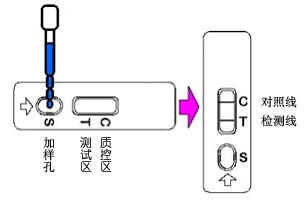
Remove the test strip from the aluminum foil bag, place it flat with the front side up as shown in the figure below, and use a pipette to add 3–4 drops of the prepared sample extract solution to the sample well.
4. Result Interpretation:
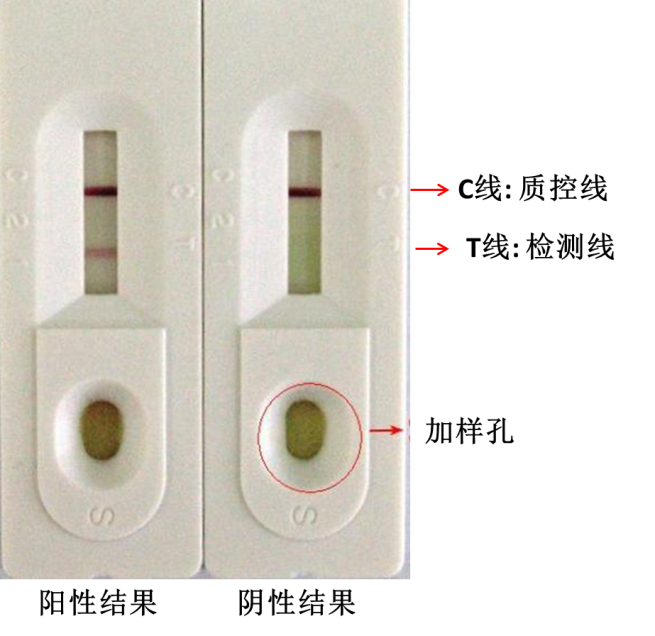
Observe the results within 5 to 10 minutes. As shown in Figure 1 below, positive results are indicated by color development at both the C line (control line) and T line (test line). As shown in Figure 2 below, negative results are indicated by color development only at the C line and no color development at the T line. If neither the C line nor the T line shows color development, or if color development occurs only at the T line and not at the C line, the test strip is invalid.
III. Precautions:
1. When testing plants, the amount of diseased leaves collected should not be excessive; strictly control the sampling volume—half or the size of a thumb nail is sufficient. Collecting too many leaves will cause the chlorophyll in the leaves to interfere with the color development during detection. Moreover, this test strip exhibits extremely high sensitivity, eliminating the possibility of false-negative results due to insufficient sample volume.
2. The test strips are stored in a dry, sealed aluminum foil bag and should be used immediately upon preparation.
3. The test strip is used for detecting PVY.
4. During sampling, leaves exhibiting pronounced mild viral symptoms should be collected. However, for most varieties infected with PVY, the viral symptoms are generally mild; in such cases, collecting the upper, more tender leaves is sufficient.
5. Collect samples using hands, scissors, or blades; after each sampling, thoroughly rinse the instruments with tap water.
6. The colloidal gold test strip must be processed using the provided sample extraction solution; other sample extraction solutions are not permitted.
7. Each pipette tube may only be used for the aspiration and addition of one sample; it is prohibited to use the same pipette tube for multiple samples.
IV. Storage Conditions: Store at room temperature (4°C–35°C) protected from light; do not refrigerate or freeze.
V. Production Date and Shelf Life: The production date is indicated on the packaging box, with a shelf life of 12 months.

Copyright © 2024-2025 Hangzhou JEL Technology Co., Ltd.
All Rights Reserved. 浙ICP备2024090592号