

The bacterial leaf blight pathogen of rice represents a major threat to rice-growing regions worldwide; not only is it widely prevalent, but it also causes significant reductions in rice yields, directly endangering global food security.
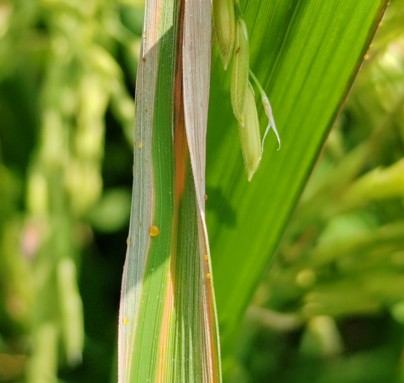
Identification of bacterial leaf blight symptoms: The disease typically begins at the leaf tips or edges, manifesting as small dark green water-soaked lesions; these lesions rapidly develop into elongated yellowish-white necrotic spots. In the later stages, the leaves turn white and wither, curling and drying out; under high humidity conditions, a pale yellow, viscous fungal discharge appears on the surface of the affected leaves; upon drying, a yellow, fish-egg-shaped fungal sclerotium becomes visible.
Immunoassay test strips are widely used due to their simple operation, rapid detection capability, and lack of dependence on complex equipment. However, traditional test strips employ colloidal gold as a signal marker, which offers relatively low sensitivity and is inadequate for the precise detection of trace-level pathogens. Therefore, developing more effective signal markers to significantly enhance the detection sensitivity of test strips has become a common objective among researchers in this field.
1. Detection Principle
The Rice bacterial leaf blight colloidal gold immunochromatographic test strip is a qualitative detection reagent strip. This test strip specifically detects Rhizobium solanacearum by forming a double-antibody sandwich immune complex on the detection line of a nitrocellulose membrane.
2. Scope of Application
This product is designed for the rapid detection of Xanthomonas oryzae in rice leaf or seed samples.
3. Packaging Specifications
30 pieces per box
4. Operating Procedures
(1) Sample preparation
Rice leaves: Take approximately 0.1 g of rice leaves with evident symptoms and place them in a mortar; transfer 1 mL of the extract solution from the sample processing tube into the mortar containing the leaves; then grind the sample thoroughly with a grinding rod for 3 minutes; the resulting homogenate serves as the sample detection solution.
Seed sample: Randomly select 10 seeds from each sample and place them into a sample processing tube containing 1 mL of extraction solution; then shake the tube at room temperature for 20–30 min; or use 10 seeds.
Make a lateral section, remove the rice portion, collect the remaining seed husks, and place them into a sample processing tube containing 1 mL of extraction solution; then, shake the mixture at room temperature for 20–30 min (recommended).
(2) Sample Testing
Remove the test strip from the aluminum foil bag and place it flat with the front side facing up. Use a plastic straw to draw up the leaf homogenate or seed extract, then add 3–4 drops (approximately 100 µL) to the sample well (S) on the test strip. Read the result after allowing the sample to sit for 5–10 minutes.
5、Result Evaluation
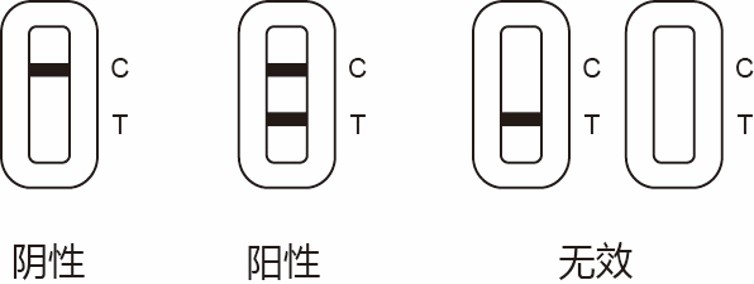
Negative (-): The C-line shows color development, while the T-line shows no color development; this is interpreted as negative.
Positive (+): Both the C-line and T-line show coloration; regardless of the intensity of the T-line color, the result is considered positive.
Invalid: The C line is not present; regardless of whether the T line is colored or not, this indicates an incorrect operating procedure or that the test strip has become invalid. In this case, please carefully re-read the instruction manual and perform the test again using a new test strip.
(1) Follow the operating instructions to perform the test; do not touch the color-development zone of the test strip during operation.
(2) This product is for single use only; do not reuse it.
(3) Do not use tap water, pure water, distilled water, or physiological saline as negative controls or sample extraction solutions.
(4) Do not use plastic straws from different samples together.
(5) After removing the test strip from the original aluminum foil bag, use it within 1 hour.
(6) Place the test strip on a flat surface for testing; then add 3–4 drops of the sample extract by vertical dropping.
(7) Since bacteria tend to sediment at rest, the sample extract should be gently mixed before using a plastic straw for aspiration.
(8) Due to variations among the samples, the color intensity of the T-and C-lines may differ; this is entirely normal.
(9) An excessively low ambient temperature during the experiment may cause abnormal test strip readings; please maintain the ambient temperature between 4–37°C.
7. Storage and Shelf Life
Storage conditions: Store the test strips in a cool, dry, light-protected environment at a temperature between 4–30°C; do not freeze them.
Shelf life: This product has a shelf life of 24 months.
Please refer to the packaging for the production date.
Copyright © 2024-2025 Hangzhou JEL Technology Co., Ltd.
All Rights Reserved. 浙ICP备2024090592号


